The Dirty Secret of AI Coding Tools Nobody Talks About
AI Can Write Code Faster — But Experienced Engineers Still Make the Critical Decisions
For years, developers worried that AI would replace software engineers completely. But something unexpected is happening inside modern tech teams.
Companies are not reducing the importance of experienced developers. In many cases, they are hiring more senior engineers than before.
Why?
Because AI-generated code is fast — but often unreliable.
Modern AI coding tools can generate APIs, React components, SQL queries, and even entire backend services in seconds. But speed alone does not guarantee quality. Teams are discovering that AI frequently produces code with hidden bugs, poor architecture decisions, security flaws, and incorrect assumptions about business logic.
As AI adoption increases, the developers who can supervise, review, and improve AI-generated code are becoming incredibly valuable.
The Hidden Cost of AI-Generated Code
AI tools are excellent at producing code patterns they have seen before. However, they struggle with context, long-term architecture, and edge cases.
Recent studies show that AI-generated code can contain up to 1.7× more bugs than human-written code.
That creates a serious problem for engineering teams.
Instead of reducing workload completely, AI often shifts the workload toward:
- debugging
- reviewing
- refactoring
- maintaining unstable code
- fixing architectural mistakes
Visual Breakdown
Traditional Development
-----------------------
Developer -> Writes Code -> Tests -> Deploys
AI-Assisted Development
-----------------------
Developer -> AI Generates Code
-> Human Reviews
-> Debugs
-> Refactors
-> Validates Business Logic
-> Deploys
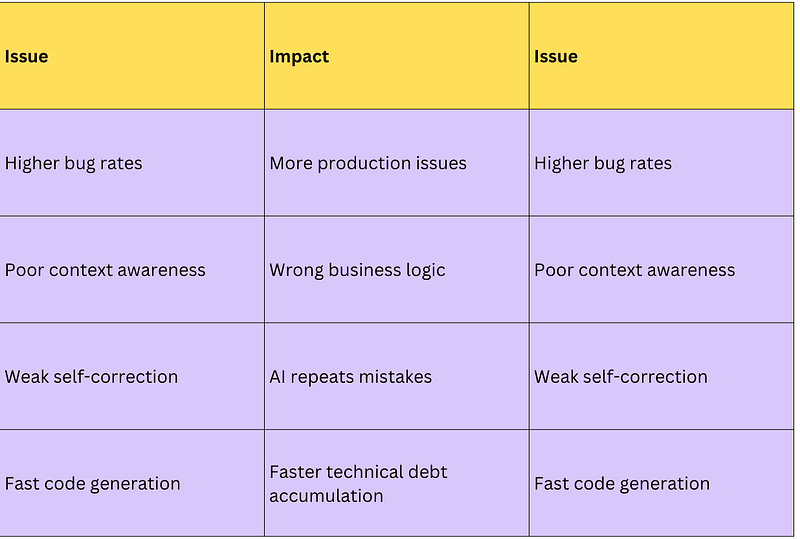
Key AI Development Challenges
Example: AI Creates a Hidden Problem
Imagine an AI tool generating authentication middleware.
AI-Generated Code
app.get("/admin", (req, res) => {
 if(req.user){
 res.send("Welcome Admin");
 }
});
At first glance, this looks acceptable.
But an experienced engineer immediately notices:
- No role validation
- Missing error handling
- No authorisation checks
- Potential security vulnerability
Senior Engineer’s Improved Version
app.get("/admin", authenticateUser, (req, res) => {
if(req.user.role !== "ADMIN"){
 return res.status(403).json({
 message: "Unauthorized access"
 });
 }
 res.status(200).json({
 message: "Welcome Admin"
 });
});
AI generated the structure.
The experienced developer added:
- security
- business rules
- maintainability
- production readiness
That difference matters enormously in real systems.
Why Companies Are Rehiring Experienced Engineers
Another interesting trend is quietly growing across the tech industry:
“Boomerang Hiring”
This refers to companies rehiring former employees who already understand:
- internal systems
- architecture decisions
- product behavior
- team workflows
- technical debt history
Reports show that nearly 35% of new tech hires are now returning employees.
Why are companies doing this?
Because experienced engineers understand both:
- the company’s systems
- AI’s limitations
That combination is extremely valuable.
Why Returning Engineers Matter
AI Tool
 ↓
Generates Generic Code
 ↓
Experienced Engineer Adds:
 • Context
 • Architecture
 • Security
 • Scalability
 • Business Understanding
A senior engineer who already knows the company ecosystem can guide AI far more effectively than someone unfamiliar with the product.
This reduces:
- onboarding time
- production mistakes
- AI misuse
- architectural inconsistency
Hiring Is Shifting From Syntax to Judgment
A few years ago, hiring focused heavily on:
- algorithms
- syntax speed
- framework memorization
Now the priorities are changing.
Teams increasingly evaluate developers based on:
- critical thinking
- decision-making
- communication
- debugging ability
- system design understanding
- collaboration skills
Why?
Because AI already handles much of the repetitive coding work.
The real value now comes from making correct technical decisions.
AI Amplifies Good and Bad Decisions
AI behaves like an amplifier.
A skilled engineer can use AI to:
- move faster
- automate repetitive tasks
- explore solutions quickly
- improve productivity
An inexperienced engineer may:
- accept incorrect outputs blindly
- introduce security issues
- create unstable architectures
- accumulate technical debt rapidly
Real-World Example
Weak AI Usage
Prompt:
"Build payment integration quickly"Result:
AI generates incomplete payment logic
without retry handling or validation.Strong AI Usage
Prompt:
"Build Stripe payment integration with:
- retry handling
- webhook validation
- idempotency
- audit logging
- failure recovery"
The difference is not the AI.
The difference is the engineer using it.
The Junior Developer Challenge
AI is also changing entry-level hiring patterns.
Many companies report reductions in junior hiring because beginners often struggle to:
- Verify AI outputs
- Detect hidden bugs
- Identify architectural problems
- Challenge incorrect code suggestions
Studies indicate:
- Junior employment dropped by 9–10%
- Many new hires struggled to manage AI-generated work effectively
This creates a difficult situation:
AI makes coding easier to start, but harder to master properly.
Why AI Still Cannot Replace Senior Engineers
AI can generate code.
But software engineering is much larger than writing syntax.
Experienced engineers understand:
- business priorities
- system scalability
- trade-offs
- legacy constraints
- deployment risks
- team coordination
- long-term maintainability
AI does not truly understand any of these concepts.
Software Development Reality
Writing Code ≠ Engineering SoftwareReal engineering includes:
- architecture planning
- stakeholder communication
- production debugging
- scalability decisions
- cost optimization
- security reviews
- performance tuning
These require judgment, not just prediction.
The Burnout Problem Nobody Talks About
There is also a hidden downside to AI adoption.
Senior developers are increasingly responsible for:
- reviewing AI-generated code
- correcting AI mistakes
- validating outputs
- mentoring teams using AI
- maintaining production quality
That creates additional cognitive pressure.
Many engineers now spend less time building systems and more time supervising AI-generated work.
This supervision layer can become exhausting if companies expect AI productivity gains without adjusting workloads realistically.
Final Thoughts
The future of software engineering is not “AI versus developers.”
It is developers working alongside AI.
The engineers who thrive will not necessarily be the fastest coders.
They will be the ones who can:
- think critically
- guide AI effectively
- understand systems deeply
- make smart technical decisions
- balance speed with reliability
AI may generate code.
But experienced developers still generate trust.
Mini Quiz for Readers
1. What is the biggest weakness of AI-generated code?
- A) Slow performance
- B) Lack of syntax support
- C) Limited contextual understanding
- D) No frontend capabilities
2. Why are senior developers becoming more valuable?
- A) They type faster
- B) They cost less
- C) They can supervise and refine AI outputs effectively
- D) They avoid using AI
3. What does AI amplify in software teams?
- A) Server costs only
- B) Good and bad engineering decisions
- C) UI animations
- D) Internet speed
If you like this article, please do support me by clapping on this article, For you it might take some seconds for me it provides me huge motivation to keep writing more.
At Dev Simplified, We Value Your Feedback 📊
👉 To read more such articles on React, visit here
👉 Follow us not to miss any updates.
👉 Have any suggestions? Let us know in the comments!