How Developers Are Using AI Wrong in 2026
AI is speeding up development — but unchecked AI-generated code is creating bugs, security risks, and massive technical debt.
AI coding assistants have become a normal part of software development in 2026. From generating APIs to writing unit tests and debugging errors, AI tools are helping developers move faster than ever.
At first glance, this sounds like a dream.
Teams ship features quicker. Boilerplate code disappears. Junior developers can suddenly build complex applications in days instead of weeks.
But behind this productivity boom, a dangerous problem is growing quietly.
Developers are increasingly relying on AI-generated code without properly reviewing it.
And that’s creating a massive trust gap.
Even though nearly 42% of production code is now AI-generated, most developers still don’t trust AI for critical business logic. Yet at the same time, many teams skip deep reviews because AI-generated code looks correct.
That contradiction is becoming one of the biggest engineering risks of 2026.
The Illusion of Faster Development
AI makes coding feel faster.
You ask for a React component, an authentication flow, or a database migration — and within seconds, the AI produces working code.
Example:
// AI-generated Express middleware
app.use((req, res, next) => {
 if(req.headers.authorization){
 next();
 } else {
 res.status(401).send("Unauthorized");
 }
});
At first glance, this seems fine.
But there are hidden problems:
- No token validation
- No expiration checks
- No role-based permissions
- No security logging
- No rate limiting
This is where many teams fail.
Instead of reviewing the logic deeply, developers often assume:
“The AI probably knows the best practice.”
That assumption is expensive.
Studies in 2026 show:
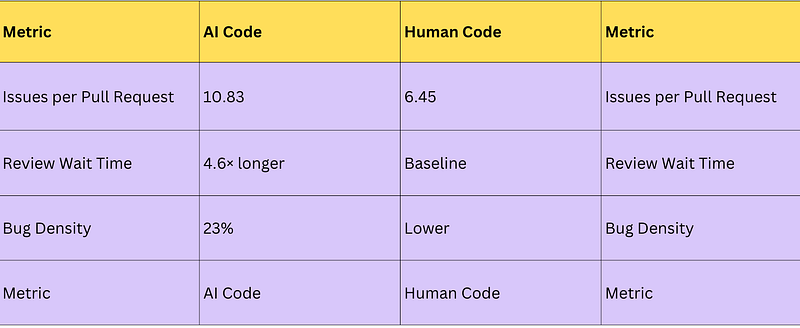
Ironically, developers feel more productive while actually becoming slower over time due to rework, debugging, and maintenance.
Why AI Pull Requests Become Dangerous
One surprising trend in engineering teams is that AI-generated pull requests often sit unreviewed much longer than human-written code.
Why?
Because reviewers assume the code is already “smart enough.”
That delay allows hidden defects to survive longer in production systems.
Here’s a simplified example of how AI-generated logic errors can slip through:
# AI-generated discount logic
def apply_discount(user, amount):
 if user.is_premium:
 return amount * 0.7
 return amount * 0.9
Looks harmless.
But imagine the business requirement was:
- Premium users → 10% discount
- New users → 30% discount
The AI misunderstood the business logic entirely.
The syntax is correct.
The architecture compiles.
But the product behaviour is wrong.
This is becoming one of the biggest hidden risks of AI-assisted development:
AI produces believable code, not guaranteed correct code.
The Technical Debt Tsunami
Technical debt is no longer just a developer buzzword.
It’s becoming a measurable business problem.
What Is Technical Debt?
Technical debt happens when teams choose fast solutions today that create extra maintenance work tomorrow.
You can think of it like this:
Quick Fix Today
 ↓
More Complexity Tomorrow
 ↓
Harder Maintenance
 ↓
Slower Development
 ↓
Even More Quick Fixes
With AI tools, this cycle is accelerating dramatically.
Organisations adopting AI-assisted coding are seeing:
- 30–41% increase in technical debt
- Code churn doubling
- 30% higher change failure rates
- 7.2% drop in delivery stability
Why AI Creates Messy Architectures
AI is excellent at generating isolated code snippets.
But large systems are not isolated snippets.
Modern applications require:
- Consistent architecture
- Shared conventions
- Performance awareness
- Security boundaries
- Scalability planning
AI struggles with long-term architectural thinking.
For example, an AI may generate:
class UserService {}
class UserManager {}
class UserProcessor {}
class UserHandler {}
All are solving nearly identical responsibilities.
Over time, this creates:
- Duplicate abstractions
- Confusing ownership
- Massive coupling
- Difficult debugging
- Inconsistent patterns
In smaller projects, this may seem manageable.
In enterprise-scale systems with hundreds of developers, it becomes chaos.
Security Risks Are Rising Fast
Security is another area where AI-generated code is causing concern.
Research shows AI-generated code is:
- 1.57× more likely to contain security vulnerabilities
- 1.75× more likely to introduce logic errors
- 1.42× more likely to create performance problems
Here’s a classic example:
// Vulnerable AI-generated SQL query
const query = `
 SELECT * FROM users
 WHERE email = '${email}'
`;
This introduces SQL injection vulnerabilities immediately.
A secure version would use parameterised queries:
db.query(
 "SELECT * FROM users WHERE email = ?",
 [email]
);
The dangerous part is that insecure AI-generated code often looks professional.
That false confidence is what makes it risky.
AI Project Failures Are Often Leadership Failures
The biggest AI problems are not always technical.
Many organisations fail because leadership treats AI like a shortcut instead of a strategic shift.
Common mistakes include:
1. No Clear Success Metrics
Teams start experimenting with AI tools without defining:
- What success means
- What risks are acceptable
- What review standards exist
2. Weak Governance
Poor data governance is causing many AI initiatives to collapse.
By 2026, many AI projects are expected to be abandoned because organisations cannot manage:
- Data quality
- Compliance
- Security requirements
- Model reliability
3. Treating AI Like a Plugin
Some companies assume AI can simply be “added” to existing systems.
But AI changes workflows, architecture, testing strategies, and operational processes.
Without redesigning engineering practices, projects become unstable quickly.
Real-World AI Failures
Several major AI failures already show what happens when oversight disappears.
Zillow’s AI Pricing Disaster
Zillow’s AI-driven home-buying system failed after market conditions shifted unexpectedly, leading to losses exceeding hundreds of millions of dollars.
The model worked historically — until reality changed.
Amazon’s Biased Hiring AI
Amazon’s hiring AI learned biased patterns from historical training data and penalised female applicants.
The issue wasn’t malicious intent.
The issue was poor oversight and unchecked assumptions.
AI Chatbot Legal Problems
AI chatbots have:
- Suggested unsafe recipes
- Created misleading legal agreements
- Produced factually incorrect advice
These failures highlight a key lesson:
AI systems are prediction engines, not truth engines.
The Future Developer Will Look Very Different
AI is also reshaping software engineering careers.
Routine coding tasks are becoming automated rapidly.
As a result:
- Junior developer hiring is shrinking
- Senior engineers are becoming more valuable
- System design skills matter more than syntax memorisation
The most successful developers in 2026 are not the fastest typers.
They are the best reviewers, architects, and decision-makers.
Future engineers will spend less time writing raw code and more time:
- Validating AI outputs
- Designing scalable systems
- Reviewing architecture
- Managing security risks
- Defining engineering standards
What Teams Must Do Next
AI itself is not the problem.
The problem is using AI without engineering discipline.
Organisations that succeed in the next wave of software development will likely follow a simple principle:
“Use AI for speed, but rely on humans for judgment.”
That means:
✅ Mandatory AI code reviews
✅ Strong architectural governance
✅ Better security testing
✅ Clear engineering standards
✅ Human oversight for critical logic
AI can absolutely improve productivity.
But only when paired with rigorous software engineering practices.