Artificial Intelligence (AI) vs Machine Learning (ML) vs Deep Learning (DL)
A beginner-friendly guide to understanding Artificial Intelligence, Machine Learning, and Deep Learning — without confusing jargon.
Most people use AI, Machine Learning, and Deep Learning as if they mean the same thing.
They don’t.
And honestly, this confusion is everywhere.
Someone says:
“AI built this.”
But what they actually mean is Machine Learning.
Or they say:
“This app uses Deep Learning.”
When it’s just a simple recommendation algorithm.
If you’ve ever felt confused by these buzzwords, you’re not alone.
By the end of this article, you’ll clearly understand:
✅ What AI, ML, and Deep Learning actually mean
✅ How they are connected
✅ Real-world examples you already use daily
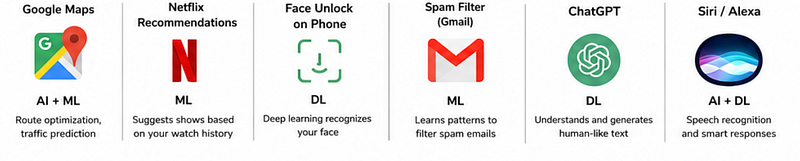
✅ Why ChatGPT, Netflix, Google Maps, and Face Unlock work differently
Let’s simplify this once and for all.
The Easiest Way to Understand It
Think of it like this:
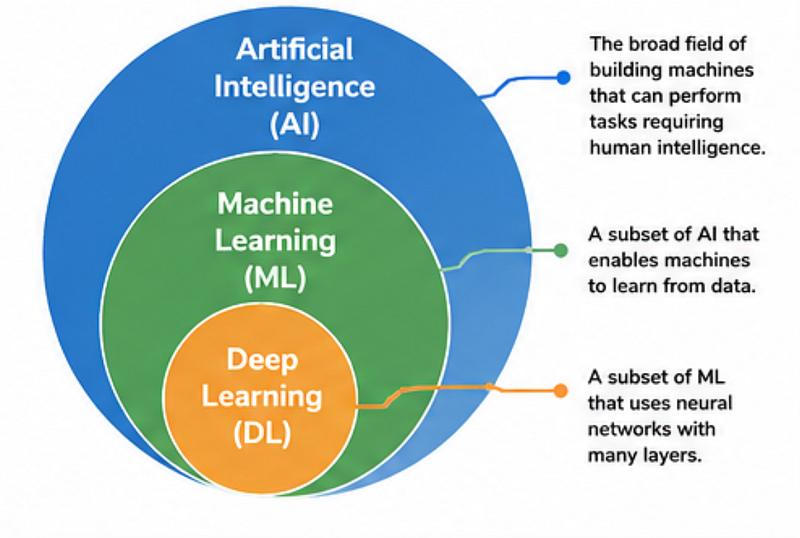
Artificial Intelligence is the big umbrella.
Machine Learning is one way to achieve AI.
Deep Learning is an advanced type of Machine Learning.
It looks like this:
Artificial Intelligence (AI)
│
├── Machine Learning (ML)
│ │
│ └── Deep Learning (DL)
If you only remember one thing from this article, remember this hierarchy.
Now let’s break them down one by one.
What is Artificial Intelligence (AI)?
Artificial Intelligence is the bigger idea.
It refers to machines performing tasks that normally require human intelligence.
Things like:
- Understanding language
- Solving problems
- Recognizing images
- Making decisions
- Learning patterns
But here’s the important part:
AI doesn’t always mean “learning.”
Sometimes AI simply follows rules.
Example: A Rule-Based Chatbot
Imagine a customer support bot.
It works like this:
if(userQuestion.includes("refund")){
 return "Visit the refund page";
}
This chatbot isn’t learning anything.
It’s just following predefined instructions.
Yet…
It is still considered Artificial Intelligence because it imitates human-like responses.
Real-Life Examples of AI
- Voice assistants (Siri, Alexa)
- Chess-playing computers
- Spam filters
- Route optimization in maps
- Smart home automation
Some AI systems are smart because humans programmed rules.
Others become smart by learning data.
That’s where Machine Learning enters.
What is Machine Learning (ML)?
Machine Learning is a subset of AI.
Instead of manually programming every rule, we train computers using data.
The system learns patterns and improves predictions over time.
Traditional Programming vs Machine Learning
Here’s the difference:
Traditional Programming
Input + Rules → OutputMachine Learning
Input + Output Data → Model Learns Rules[Flowchart: Traditional Programming vs Machine Learning]
In simple words:
Instead of telling a computer how to solve a problem…
You show examples and let it figure out patterns.
Example: Email Spam Detection
Suppose we train a model like this:

After seeing thousands of examples, the model learns patterns.
Words like:
- “Free”
- “Win”
- “Urgent”
- “Offer”
might indicate spam.
Simple ML Example in Python
from sklearn.linear_model import LogisticRegression
model = LogisticRegression()
emails = [[1,0], [0,1], [1,1]]
labels = [1,0,1]
model.fit(emails, labels)
What this code does
This trains a basic model using sample data.
The computer starts identifying patterns instead of relying on hardcoded rules.
Common Beginner Mistake
Many people think:
“Machine Learning means the machine thinks like humans.”
Not really.
ML is mostly pattern recognition using data.
It predicts based on probability.
Not magic.
What is Deep Learning (DL)?
Deep Learning is a specialised branch of Machine Learning.
It uses something called neural networks, inspired loosely by how the human brain works.
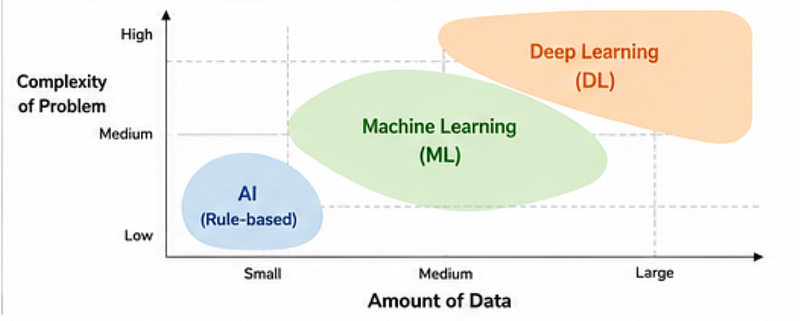
Deep Learning is extremely powerful when dealing with:
- Images
- Speech
- Videos
- Natural language
- Complex patterns
Why “Deep”?
Because the neural network contains many layers.
Think of it like this:
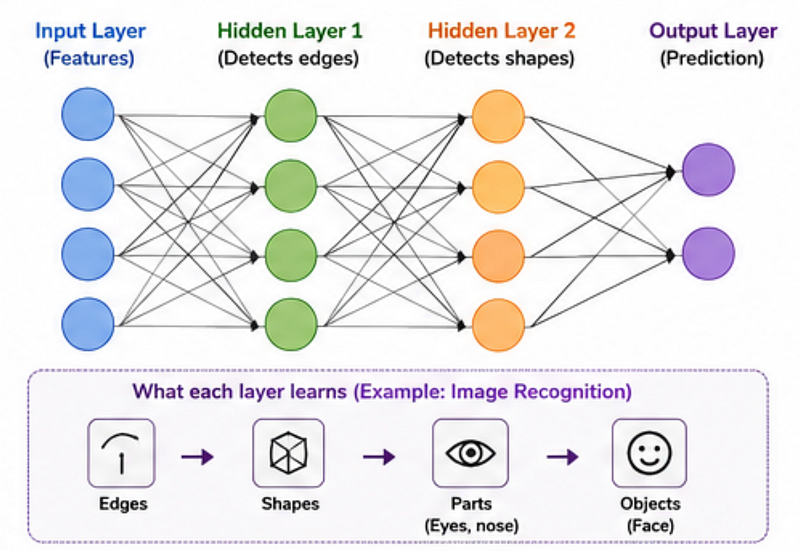
Each layer learns something deeper.
Example in image recognition:
- Layer 1 → detects edges
- Layer 2 → detects shapes
- Layer 3 → detects eyes
- Layer 4 → recognizes faces
That’s why Face Unlock feels so smart.
Example: Face Recognition
Traditional ML might struggle with:
- Lighting changes
- Different angles
- Expressions
Deep Learning handles these much better because it learns highly complex patterns.
That’s why apps like:
- Face Unlock
- Google Photos
- Self-driving systems
- Voice assistants
- Language models like ChatGPT
depend heavily on Deep Learning.
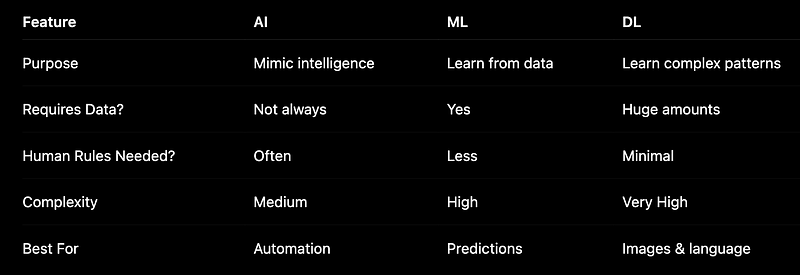
AI vs ML vs DL — Quick Comparison
A Simple Analogy
Imagine teaching a child to identify dogs.
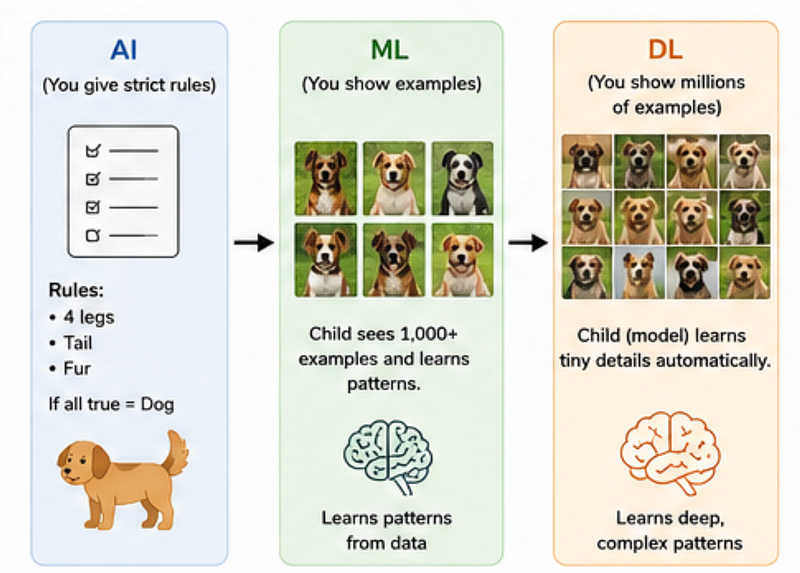
AI
You give strict rules:
Four legs + tail + fur = dog
Machine Learning
You show 1,000 dog photos.
The system learns patterns.
Deep Learning
You show millions of photos.
It automatically learns tiny visual details humans might miss.
This is why Deep Learning became such a big breakthrough.
The Surprising Truth Most People Miss
Here’s something unexpected:
Not every problem needs Deep Learning.
This surprises many beginners.
Companies often avoid Deep Learning because:
- It needs huge data
- It requires powerful GPUs
- Training costs are high
- Results are harder to explain
Sometimes a simple Machine Learning model works just as well.
In real-world business:
Simple often beats fancy.
A spam filter may not need a billion-parameter AI.
A smart recommendation system might only need good Machine Learning.
That’s a practical lesson many people learn too late.