Why Great Developers Still Fail Technical Interviews in 2026 (Even When They Can Code)
The hidden shift in hiring: companies now evaluate how you think, communicate, and work with AI — not just whether your code runs.
If technical interviews feel harder in 2026, you’re not imagining it.
Many strong developers are getting rejected despite having real skills, solid experience, and correct solutions. The reason? Hiring has changed faster than interview prep advice.
Companies are no longer testing only coding ability. They now evaluate reasoning, communication, judgment, and AI collaboration.
That means someone who writes perfect code silently may lose to someone who explains trade-offs clearly, handles ambiguity well, and verifies AI-generated output intelligently.
Let’s break down what’s really happening.
The Old Interview Is Dead
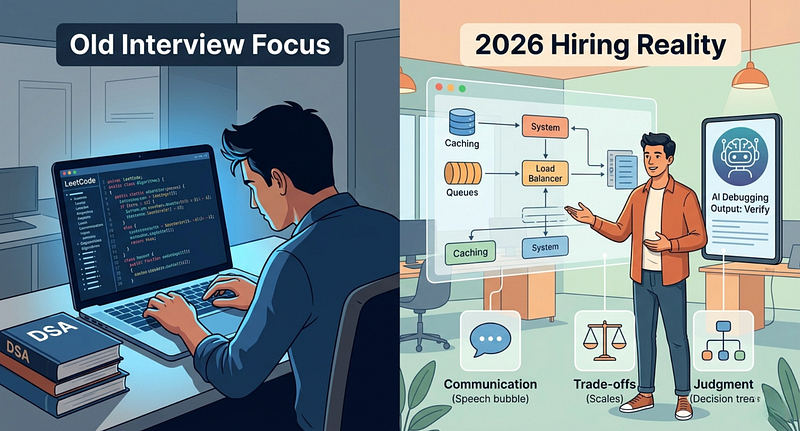
A few years ago, success often meant:
- Solving LeetCode fast
- Memorizing patterns
- Writing optimised code quickly
- Surviving whiteboard pressure
Today, that’s only part of the picture.
Modern teams want developers who can function in real-world engineering environments.
That means interviews now simulate tasks like:
- Reviewing AI-generated pull requests
- Explaining architecture decisions
- Debugging incomplete systems
- Making trade-offs with limited information
- Communicating under pressure
In many companies, how you solve matters more than simply solving.
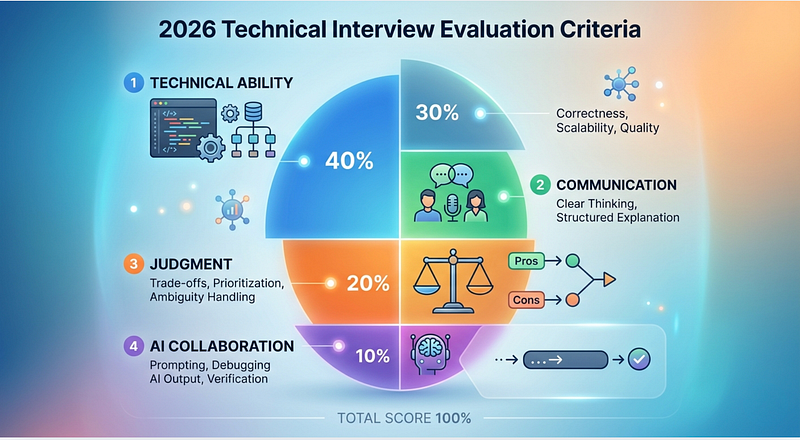
What Interviews Actually Measure in 2026
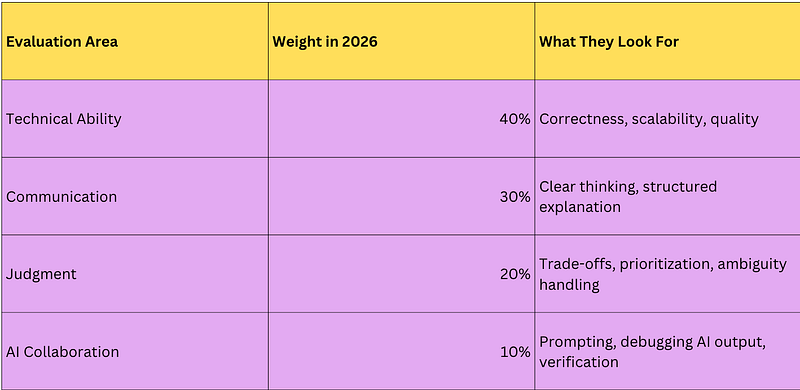
A candidate may write correct code — but if they can’t explain why they chose that approach, they often lose points.
The Silent Candidate Problem
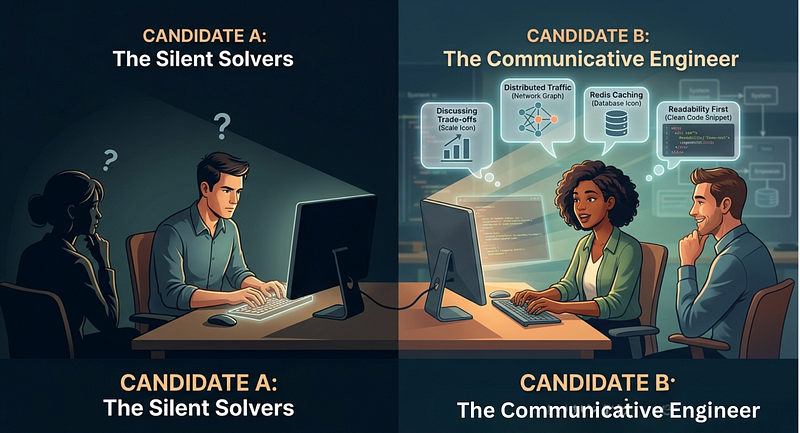
Imagine two candidates solving the same API rate-limiting problem.
Candidate A:
Writes clean code silently.
Candidate B:
Writes decent code and says:
- “I’ll optimise later for readability first.”
- “This may fail under distributed traffic.”
- “Redis could solve concurrency issues.”
- “Given time constraints, I’d ship this version first.”
Who sounds more hireable?
Usually Candidate B.
Because companies hire engineers, not typing machines.
AI Has Entered the Hiring Process
By 2026, AI is involved in nearly every hiring stage:
- Resume screening
- Video interview scoring
- Communication analysis
- Coding review assistance
- Scheduling and coordination
Some platforms evaluate:
- Speech clarity
- Sentiment
- Consistency
- Engagement
- Answer structure
That means your interview performance may be scored before a recruiter even watches it.
Why Good Developers Never Reach Interviews
This is one of the biggest hidden problems.
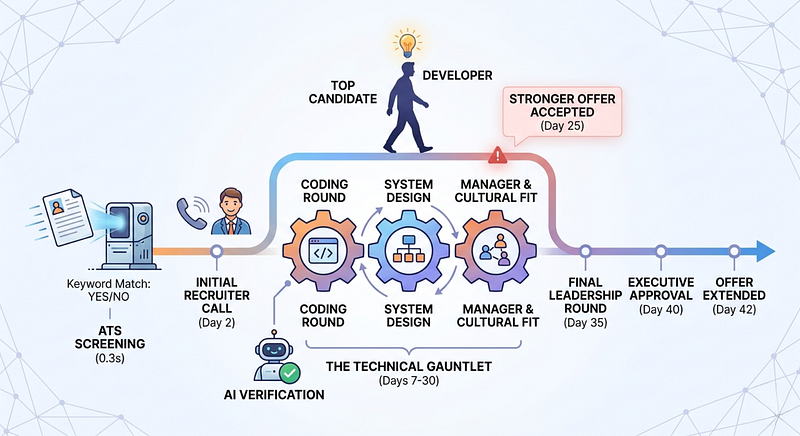
AI-powered ATS systems reject resumes in under 0.3 seconds for reasons like:
- Missing keywords
- Wrong formatting
- Different job titles
- Non-traditional experience
- Contract/freelance history
Example:
A resume says:
Built backend APIs using Node.js
Job description says:
Experience with Express.js REST services
Even if the skills match, a keyword mismatch may reduce ranking.
Quick Summary: Beating ATS in 2026
- Mirror keywords naturally from job descriptions
- Use clean formatting
- Mention measurable impact
- Include tools explicitly
- Avoid fancy resume templates
LeetCode Alone Is No Longer Enough
Many candidates still prepare like it’s 2021:
- Solve 300 DSA problems
- Memorise graphs/DP tricks
- Ignore system design
- Ignore the communication practice
That’s risky now.
Real engineering work often involves:
- Debugging AI-generated code
- Understanding bad architecture choices
- Handling unclear requirements
- Balancing speed vs maintainability
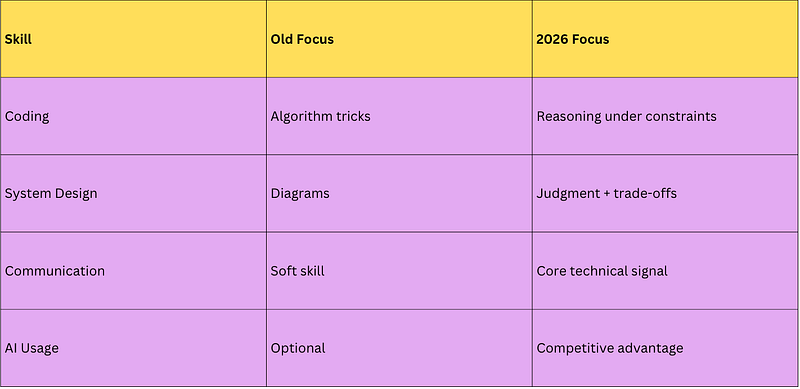
The Comparison Shift
Can You Work With AI… Safely?
This is now a major signal.
Companies know developers use tools like Copilot and LLMs.
But they don’t just ask “Do you use AI?”
They ask:
- Can you verify the AI output?
- Can you catch hallucinations?
- Can you improve the generated code?
- Can you use AI without over-depending on it?
Example
function isEven(n){
 return n % 2 == 1;
}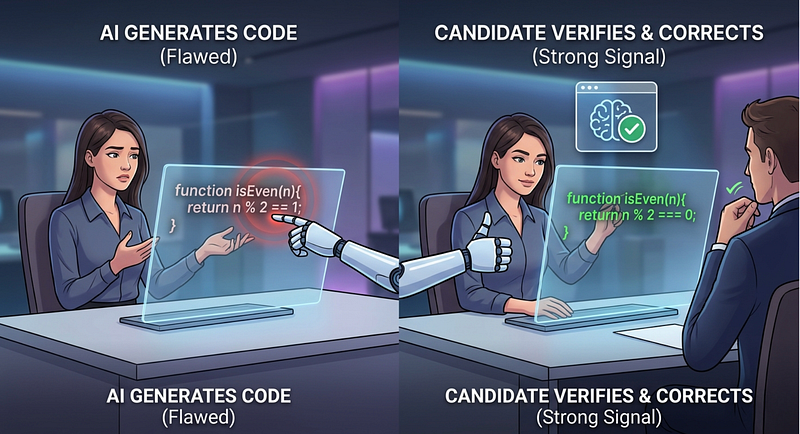
An AI tool may generate flawed logic.
A strong candidate says:
- “This is incorrect.”
- “Should return
n % 2 === 0.” - “Also use strict equality.”
function isEven(n){
 return n % 2 === 0;
}
Many companies still run:
- Recruiter round
- Coding round
- Manager round
- System design
- Culture fit
- Final leadership round
Average hiring cycles can stretch to 42 days.
Meanwhile, strong candidates often accept offers much earlier.
Common Candidate Reaction
“If your hiring process is chaotic, your engineering process might be too.”
How to Prepare for Interviews in 2026
1. Practice Thinking Out Loud
Explain:
- assumptions
- trade-offs
- edge cases
- alternatives
2. Learn Practical System Design
Focus on:
- scaling basics
- caching
- queues
- databases
- cost trade-offs
3. Become AI-Literate
Use AI tools daily, but verify outputs.
4. Optimise Your Resume for Humans + ATS
Use a clean structure and relevant keywords.
5. Simulate Real Interviews
Practice coding while speaking clearly.
Pro Tip
Record yourself solving one problem aloud.
You’ll instantly notice:
- filler words
- unclear logic
- rushed thinking
- weak explanation flow
Fixing communication often improves results faster than solving 50 more DSA questions.
Final Takeaways
Good developers fail technical interviews in 2026 not because they lack skill.
They fail because hiring now rewards a broader skill set:
- Clear communication
- Sound judgment
- Real-world trade-offs
- AI collaboration
- Structured thinking under pressure
Coding is still important.
But coding alone is no longer enough.
The real question is:
Are you preparing for interviews from the past — or the ones happening now?
At Dev Simplified, We Value Your Feedback 📊
👉 To read more such articles on React, visit here
👉 Follow us not to miss any updates.
👉 Have any suggestions? Let us know in the comments!