Part 5: AWS SQS, SNS, and EventBridge — The Messaging Backbone You Can’t Ignore in 2025
Day 5 of AWS Cloud Practitioner Essentials, Monolith, Microservices, Tightly, and Loosely coupled architecture
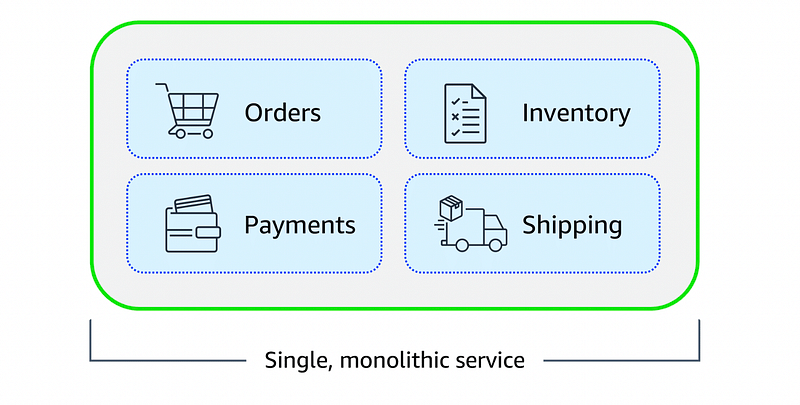
Tightly Coupled Monolith Architecture
In the early days, most companies built fast—stacking logic, UI, and databases into a single, neat, working app.
Doesn’t matter how one module is dependent on another. If it's working fine, then it’s good to go.
However, as traffic grows, complexity increases. Even a single bug can take your whole system down.
That’s the curse of a tightly coupled monolith.
So, how do you avoid that?
You decouple. You communicate through messages.
And in AWS, the magic trio that makes that happen is:
- Amazon SQS
- Amazon SNS
- Amazon EventBridge
Let’s break down why this shift matters and how these tools can be the backbone of a reliable, scalable, future-proof architecture.
Monolithic vs. Microservices: The Coffee Shop Analogy
Imagine you’re running a coffee shop.
In the monolith model:
- The cashier takes orders,
- Runs to the kitchen,
- Give it to the Barista
- The barista makes the coffee,
- And hands over the drink.
This works well until the Barista and the Cashier are in sync. But what if one of them is not available? Let’s say Barista is not available, then the cashier has to wait, and the ordering line will be increasing with frustrated customers, making the whole coffee shop's sales go down.
That’s a tightly coupled system — where every function is stacked in one place, depending on each other in real-time.
Now imagine this instead:
- The cashier takes an order and drops it into the system in a queue.
- A barista picks up orders from the queue.
- A delivery app gets triggered only when an order is ready.
If something breaks, like Barista not being available for some time, still the cashier can keep taking orders, and once Barista is back(Server is up and running again), it can process the orders..
That’s the power of decoupling with message-based architecture. Let’s go deeper.
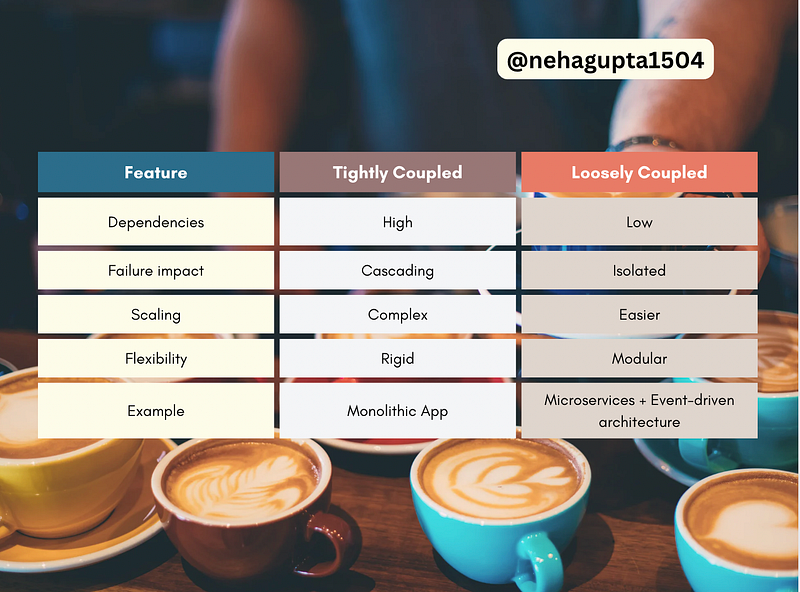
Tightly Coupled vs Loosely Coupled Architectures
Enter the Trio: SQS, SNS, EventBridge
1️⃣ Amazon SQS (Simple Queue Service)
The go-to solution for decoupling services with queues.
☕️ Use Case:
In a banking system, transaction data is sent to a fraud detection service. But what if that service is temporarily down?
SQS stores the transaction event safely and delivers it once the service is back up.
No data lost. No downtime. No tight dependency.
- Real-World Analogy: A Support agent takes complaints and drops them in a queue. A technical team picks them when available. It doesn’t matter if they’re busy right now — the complaint is saved and processed later.
2️⃣ Amazon SNS (Simple Notification Service)
A publish-subscribe model where one message can trigger multiple actions.
☕️ Use Case:
You want to send product updates to customers, but they only want what’s relevant.
SNS lets users subscribe to specific topics — say, deals, events, or launches.
Your backend sends one message, and SNS handles delivering it to the right audience.
- Real-World Analogy: If Amazon is having a black day sale and wants to send a notification to its customers. Will it be sending generic notifications? Think about this…
Why it matters:
You don’t write 10 different “if user wants X, send Y” conditions in your code. SNS manages the routing for you based on the topics.
3️⃣ Amazon EventBridge
Your best friend for serverless, event-driven communication across AWS services, custom apps, and third-party tools.
☕️ Use Case:
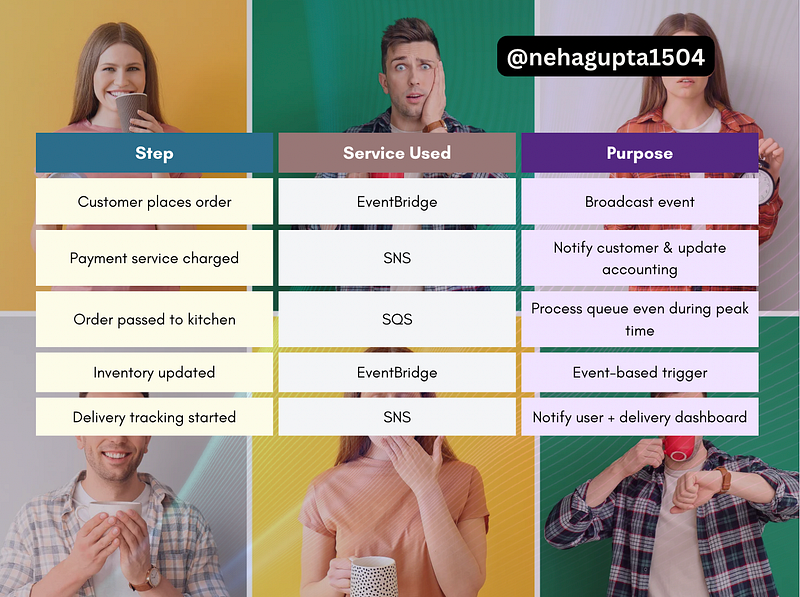
In a food delivery app, a customer places an order.
EventBridge helps:
- Notify the payment service
- Alert the kitchen
- Trigger inventory updates
- Send the order status to the delivery team
All without them , depending on each other’s availability.
And if the inventory service is down?
EventBridge buffers the event and delivers it once the service is back.
Why it matters:
- Scales effortlessly during peak hours.
- Makes failure handling easy.
- Keeps services decoupled and modular.
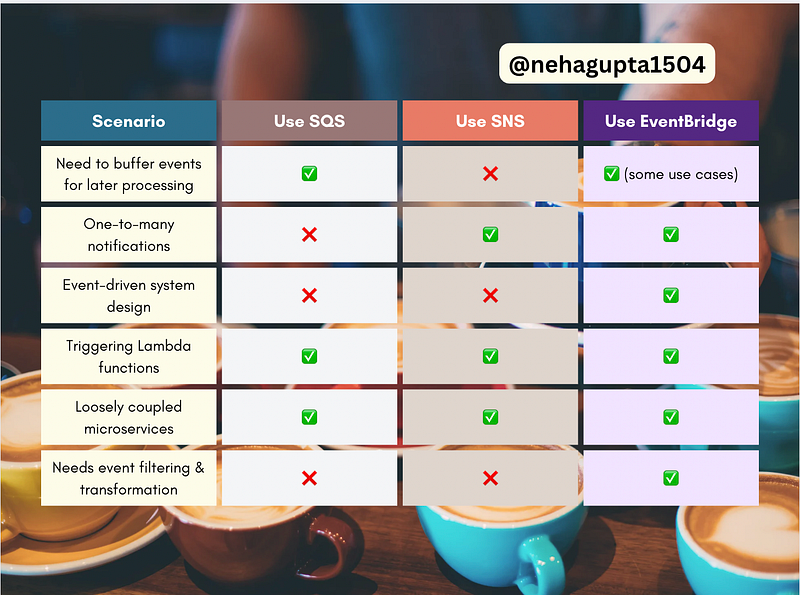
Which One to Use When?
Real Example: Scaling a Food Delivery App
Final Thoughts: Event-Driven is the Future
If you’re still building apps where services talk directly to each other, you’re setting yourself up for future crashes and headaches.
- Decouple with queues
- Scale with events
- Notify with intent
SQS, SNS, and EventBridge aren’t “nice-to-haves” anymore. They’re the foundation of modern, resilient cloud apps.
Coming Up Next
Part 6: Provisioning AWS Resources
Over to You
Have you used SQS, SNS, or EventBridge in a real project?
What challenges did you face moving from monolith to microservices?
Let’s discuss in the comments.👇
If you like reading my articles, you can always support my writings by buying me a cup of coffee here ☕️ .
Let me take the hot sip and enjoy 😉
At Dev Simplified, We Value Your Feedback 📊
👉 Follow us to not miss any updates.
👉 Have any suggestions? Let us know in the comments!