The Pattern Behind The Problems: How To Dominate DSA Interviews
Introduction
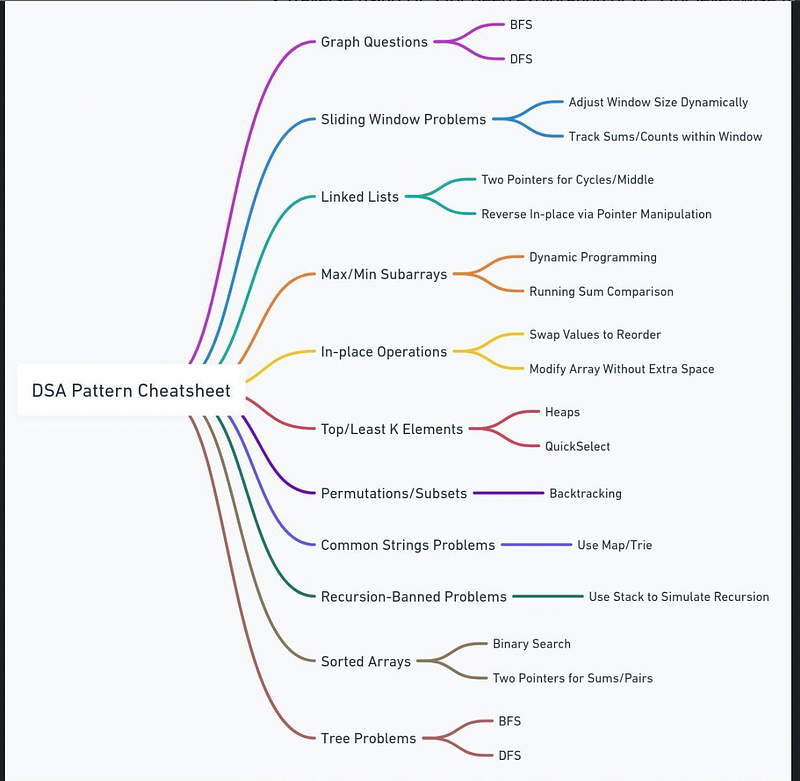
Are you struggling to crack Data Structures and Algorithms (DSA) interview questions? Do you want to improve your problem-solving skills and become a proficient programmer? Look no further! This cheat sheet provides a comprehensive overview of the most common DSA patterns, covering 90–95% of interview questions. With this powerful resource, you’ll be able to tackle even the toughest problems with confidence.
Graphs
• Apply DFS/BFS to traverse the graph
• Use adjacency lists for efficient representation
• Focus on detecting cycles/shortest paths
Sliding Window
• Adjust the window size dynamically based on constraints
• Use two pointers to track the current window
• Track sums or counts within the window
Linked Lists
• Use Two Pointers to detect cycles & find the middle node
• Reverse the list in place by pointer manipulation
Maximum/Minimum Subarrays
• Use Dynamic Programming to track the optimal subarray
• Maintain a running sum and compare with current maxi/mini
• Divide the problem into subproblems to simplify calculations
In-Place Operations
• Swap corresponding values to reorder the array
• Modify the array without using extra space
• Carefully manage index positions during swapping to avoid overwriting
Top/Least K Elements
• Use Heaps to keep track of the top/least K elements efficiently
• QuickSelect can help when sorting isn’t necessary
• Maintain a limited window of values for optimal memory usage
Permutations/Subsets
• Apply Backtracking to explore all possible combinations
• Prune paths that won’t lead to valid solutions early
• Track the current state and revert changes after each recursive call
Common Strings
• Use a Map/Trie to store and search for prefixes or entire strings
• Count frequencies to detect patterns or duplicates
Recursion-Banned Problems
• Use Stack to simulate recursive calls iteratively
• Track the state manually to mimic the recursive behavior
• Push and pop values carefully to ensure you’re following the intended logic
Sorted Arrays
• Use Binary Search to quickly narrow down the target range
• Use sorted properties to optimize space/time complexity
• Use Two Pointers for sums or pairs
Tree Problems
• Traverse using DFS for deep exploration or BFS for level-wise traversal
• Keep track of visited nodes to avoid infinite loops
• Handle edge cases like unbalanced trees or missing nodes
General Tips
• Use Maps/Sets for O(1) lookups and efficient space management
• Sorting can simplify problems to O(nlogn) time
Conclusion: Confidently Dominating DSA Interviews
Now that you have this extensive DSA pattern cheat sheet, you are prepared to answer a variety of interview questions. You will be well on your way to slaying your next DSA interview and getting your ideal job if you can grasp these patterns and advice. Have fun with your coding!
At Dev Simplified, We Value Your Feedback 📊
👉 Have any suggestions? Let us know in the comments!