How average developers are landing 50+ LPA jobs, Here’s how
The developers getting better opportunities are not always better at DSA. Often, they are better at choosing what to learn, where to apply, and how to become someone a team can rely on.

The mistake that I see when developers prepare for their next job.
They assume they need to become way better at coding before they can start applying for jobs.
- So they solve another 300+ LeetCode problems.
- Then another course.
- Then another project.
Six months later, their GitHub shines, their notes have grown, but their job search looks exactly the same.
That is the important part worth understanding.
Because getting a better software job is not purely a competition to become the most technically skilled person in the applicant pool.
Sometimes the bigger advantage is knowing which companies to target, what those companies actually evaluate, and which skills make you useful once you’re hired.
That distinction becomes even more important when you look beyond traditional Indian product-company hiring and start considering startups or international remote teams.
The original experience behind this argument comes from someone who has worked across service, product and remote companies and has also been on both sides of technical interviews.
The First Mistake: Preparing Without a Target
When I first started preparing for interviews, I thought more preparation automatically meant better preparation.
It doesn’t.
Imagine you’re a backend developer targeting three companies.
- Company A heavily evaluates DSA.
- Company B wants strong Java, Spring Boot and distributed-system fundamentals.
- Company C is a small remote SaaS company looking for somebody who can independently build APIs, debug production problems and work asynchronously.
Preparing identically for all three makes little sense.
Yet that is exactly how many developers prepare.
Learn DSA
↓
Learn system design
↓
Build random project
↓
Learn another framework
↓
Start applying everywhere
A better process starts backwards.
Target companies
↓
Study their engineering work
↓
Study recent interview experiences
↓
Identify recurring requirements
↓
Find your skill gaps
↓
Prepare specifically for those gaps
That sounds obvious.
I didn’t treat it as obvious early in my career.
That is a much more useful definition of upskilling.
Remote Interviews Can Optimise for Different Things
There is another assumption worth questioning:
Every good software job requires the same interview preparation.
It doesn’t.
Some large technology companies use algorithm-heavy interview loops. Other companies, particularly smaller teams, may put considerably more weight on the work you will actually perform.
For a backend developer, that could mean discussing:
- REST API design
- database modelling
- authentication
- caching
- production debugging
- framework internals
- previous architectural decisions
I would add an important caveat: remote does not mean easy.
Remote hiring frequently shifts the difficulty somewhere else.
GitLab, one of the longest-running large all-remote companies, explicitly looks for self-management and strong written communication during remote hiring.
You may solve fewer dynamic-programming questions and still fail because you cannot explain a decision clearly, work independently, or turn an ambiguous requirement into something shippable.
That leads to a much more interesting skill.
Become the Engineer People Can Trust With a Problem
Suppose two developers know roughly the same JavaScript.
Developer A knows more obscure framework APIs.
Developer B can receive:
“Checkout is occasionally creating duplicate orders.”
…and methodically work through logs, reproduce the issue, identify a race condition, fix it, add a regression test and explain what happened.
Who would you rather have during a production incident?
This is why I think the word average becomes misleading.
You can be average at competitive programming while being extremely useful in a software team.
Those are not contradictory.
A reliable engineer can:
- understand an unfamiliar codebase,
- ask useful questions,
- debug without immediately escalating everything,
- communicate blockers early,
- test what they ship,
- deliver when they say they will.
That sounds less impressive than “10x engineer.”
In actual projects, it is incredibly valuable.
Use Job Descriptions as Data
Here is one practical exercise I wish more developers did.
Collect 20 job descriptions for the role you want.
Then find recurring skills.
You don’t even need an AI tool for the first pass.
const jobs = [
 "Node.js PostgreSQL Docker AWS REST APIs",
 "Node.js TypeScript PostgreSQL Redis AWS",
 "TypeScript Node.js Docker Kubernetes PostgreSQL",
];
const skills = [
 "node.js",
 "typescript",
 "postgresql",
 "docker",
 "aws",
 "redis",
 "kubernetes",
];
for (const skill of skills) {
 const count = jobs.filter(job =>
 job.toLowerCase().includes(skill)
 ).length;
 console.log(`${skill}: ${count}/${jobs.length}`);
}
This tiny script answers something useful:
What does the market I’m targeting repeatedly ask for?
With real data, your result might look like:
node.js: 18/20
postgresql: 15/20
aws: 13/20
docker: 11/20
kubernetes: 4/20
Now your learning priorities become clearer.
Spending three weeks improving PostgreSQL and AWS may be more valuable for those particular roles than spending three weeks learning a technology appearing in only one listing.
The common mistake is treating every missing keyword as equally important.
It isn’t.
Look for frequency first. Then depth.
Networking Is Not Asking Strangers for Referrals
“Network more” is one of those pieces of career advice that becomes almost useless without explaining what it means.
I prefer something more specific.
Find engineers already doing the job you want.
Instead of immediately asking:
“Can you refer me?”
Ask:
“What does your team expect a backend engineer with three years of experience to handle independently?”
That answer can change your preparation.
Follow engineers working at companies you’re interested in. Read their engineering posts. Observe what they build. Look at open roles before you need a job.
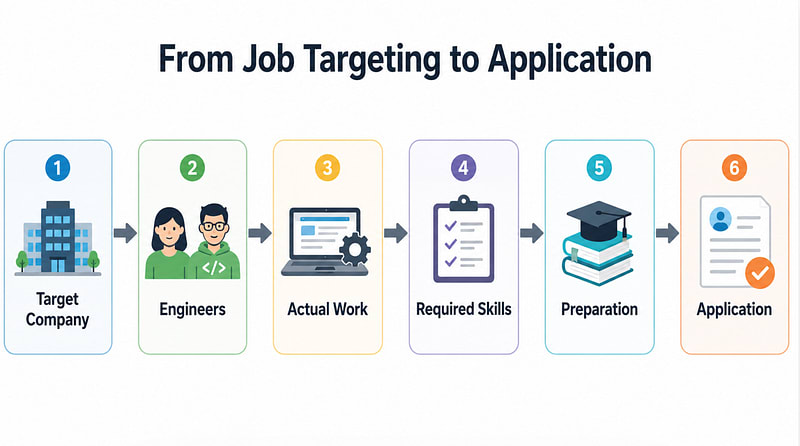
That is networking as information gathering.
Referrals may come later.
AI Changes the Skill Mix, Not the Need for Engineering Judgment
There is also a tempting argument right now that AI makes fundamentals less important.
I think the opposite lesson is safer.
AI can write implementation code quickly.
But somebody still needs to notice when that code is wrong.
The evidence here is mixed rather than one-directional. Recent research on AI-native software engineering describes productivity gains as highly context-dependent and argues that judgment, verification and orchestration are becoming increasingly important skills.
So this:
const result = await ai.generateCode(requirement);is not the valuable skill.
This is closer:
const result = await ai.generateCode(requirement);
await reviewArchitecture(result);
await runTests(result);
await checkSecurity(result);
await verifyEdgeCases(result);
Not literally those four functions, obviously.
The point is the mindset.
AI can help produce an implementation.
You still own the result.
And that may actually increase the value of developers who understand APIs, databases, networking, security, testing and system behaviour well enough to review what AI produces.
The Surprising Part: Remote Work Hasn’t Disappeared
Return-to-office headlines can make fully remote development look almost extinct.
It isn’t.
Stack Overflow’s 2025 developer survey found that nearly one-third of responding developers were still working remotely.
At the same time, remote opportunities should not be romanticised.
They can be competitive, some companies restrict hiring by country, compensation varies enormously, and remote work is not automatically synonymous with better work-life balance.
Even GitLab explicitly notes that remote work does not suit everyone.
So I would not tell someone:
“Remote jobs are easier and pay ₹50 lakh.”
I would tell them:
“International remote companies create a different pool of opportunities. Learn how those companies hire before deciding whether they fit your strengths.”
That difference matters.
What Changed in How I Think About Job Preparation
The biggest change for me was separating learning software engineering from preparing for a specific job.
Both matter.
But they are different activities.
You can spend years becoming a better engineer.
A job search needs a much tighter feedback loop.
- Pick companies.
- Understand their expectations.
- Identify the gap between those expectations and your current abilities.
- Close that gap.
- Then apply.
- Repeat.
It sounds almost too simple, which is probably why people keep replacing it with another course.
The Takeaway
You do not need to become the best developer in the market before looking for a better opportunity.
You need enough technical depth to do the job, enough judgment to recognise what you don’t know, and enough reliability that another engineer can trust you with something important.
Then become deliberate about where you look.
Don’t prepare for “software engineering jobs.”
- Prepare for a specific kind of engineering role at a specific kind of company.
- Study the people already doing that work.
- Build the skills those teams repeatedly need.
- Use AI to accelerate execution, not replace understanding.
And stop assuming the developer who knows the most algorithms automatically gets the best career.
Sometimes the developer who understands the market better simply finds a better door.
From Tech By Neha Gupta
- 👏 Enjoyed the article? Don’t forget to leave a clap.
- 💬 Have thoughts or questions? Share them in the comments.
Before you go
- Please take a moment to like the post and follow the writer!
- Did you know that over 400,000 developers share what they’re building, learning, and discovering across our platforms every month? Learn how you can contribute here